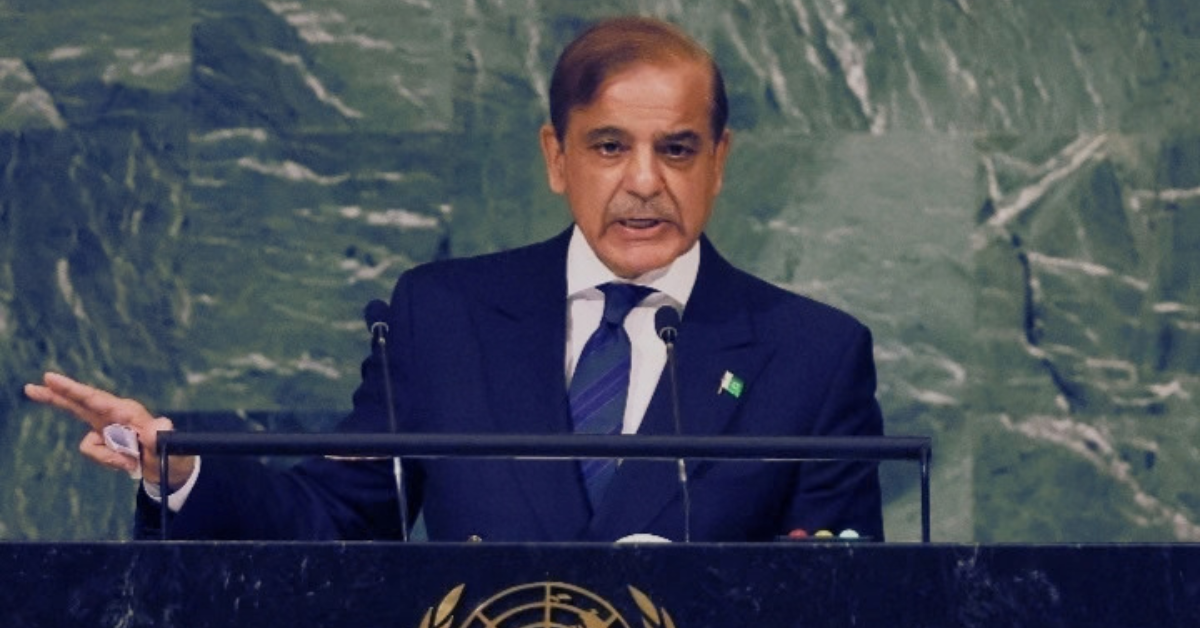
Pakistani Prime Minister Shehbaz Sharif, while addressing the United Nations General Assembly on September 25, 2026, warned India that stopping, obstructing, or diverting Pakistan’s share of water would be considered an “act of war” by Pakistan. Prime Minister Shehbaz Sharif spoke on topics including Kashmir as Pakistan’s jugular vein, Trump’s role as a mediator, the dark future of Gaza’s children, demands from the Afghan government, and the Mecca Defense Agreement.
Table of Contents
What Is the Indus Waters Treaty?
Pakistan and India signed the Indus Waters Treaty in 1960, under which the water of the three western rivers, the Indus, Jhelum, and Chenab, was allocated to Pakistan, while the three eastern rivers, Ravi, Beas, and Sutlej, were allocated for India’s use. Neither country can divert, stop, or obstruct the flow of water belonging to the other country.
Violation of the Indus Waters Treaty
India showed stubbornness and, in April 2025, announced that it was temporarily suspending the treaty, in violation of the Indus Waters Treaty, further increasing tensions between Pakistan and India. Pakistan rejected the decision and maintained that India could not unilaterally suspend the treaty.
Indus Waters Treaty and the Permanent Court of Arbitration

Pakistan presented the water dispute before the Permanent Court of Arbitration in The Hague. On August 31, 2026, the court ruled that the Indus Waters Treaty would remain in force and that no country could unilaterally terminate the treaty. It also stated that India must fulfill its responsibilities under the Indus Waters Treaty. However, India rejected the court’s decision.
Use of Water as a Weapon
Prime Minister Shehbaz Sharif stated at the General Assembly that India should not use water as a weapon. He said the purpose of water is to bring nations together, create love and cooperation, and support their development, not to divide them. He said the Indus River is the “jugular vein” of the entire region.
Pakistan Blamed for the Pahalgam Incident
Prime Minister Shehbaz Sharif referred to the Pahalgam incident, which occurred on April 25, 2025, in the Pahalgam area of Indian-administered Kashmir, where tourists were attacked and 26 people were killed. India blamed Pakistan for the incident without an investigation. Pakistan rejected the allegation and called for an impartial investigation.
He said, “Our brave and courageous armed forces, under the bold leadership of Field Marshal Asim Munir, carried out a response with the highest precision and professionalism.”
India-Pakistan War and Trump’s Role as a Mediator

Shehbaz Sharif praised Trump’s role as a mediator in the India-Pakistan ceasefire in May 2025 and said that Trump’s firm commitment, leadership, and mediation efforts saved the lives of 300 million people. He said that the region must ensure that South Asia does not reach such a dangerous point again.
Kashmir Is Pakistan’s Jugular Vein
Shehbaz Sharif further said that the people of Kashmir have been fighting for their freedom for eight decades and have faced disappearances, violence, detention, and all forms of oppression. Pakistan will continue to provide diplomatic, moral, and political support for Kashmir’s freedom. Kashmir is Pakistan’s jugular vein.
Iran-US War and Pakistan’s Role as a Mediator
During his address, Shehbaz Sharif highlighted the situation in the Gulf region and the Middle East, particularly the issue of the Strait of Hormuz. He said that in this critical situation, Pakistan played a mediating role between Iran and the United States through firm commitment, strong leadership, and negotiations. Pakistan brought Iran and the United States together under one roof in Islamabad and paved the way for negotiations, and in June, Iran and the United States signed a memorandum of understanding.
Shehbaz Sharif Praises Field Marshal Asim Munir

Shehbaz Sharif praised the Chief of Defence Forces, Field Marshal Asim Munir, and said that his tireless efforts helped create space for diplomacy under extremely difficult and challenging circumstances.
He further said that the Strait of Hormuz and Bab al-Mandab are lifelines of the global economy. They should be kept open and used to build stronger relations among nations rather than creating paths toward confrontation. Amid the roar of missiles, drones, attacks, and bombs, the voice of peace should be made louder and stronger.
Joint Mecca Defense Agreement
Addressing the United Nations General Assembly, Shehbaz Sharif strongly condemned the recent Houthi attacks on Saudi Arabia and also mentioned the Mecca Defense Agreement, which was concluded on September 17, 2026, in the Saudi city of Mecca. He said the purpose of the agreement is to strengthen defense and peace and that the alliance is not directed against any country or region.
Israel’s ‘Genocidal Agenda’
Shehbaz Sharif strongly reacted to Israel’s genocidal agenda in Gaza and said that last year, “a five-year-old innocent girl, who was trapped in a vehicle with her family for five hours in Gaza and was later shot dead by Israeli forces, was killed. What was her fault?” He questioned when Israel would stop such actions and its agenda.
The Dark Future of Gaza’s Children
Every child born in Gaza is not living a normal life like children elsewhere in the world and cannot see a bright future. Israel is making the future of Gaza’s children dark. This year, an eight-year-old girl, Wafa Aqila, was killed on the first day of school. Israel’s attacks on schools are a sign of the dark future facing the current generation.
Terrorism and the Brave Armed Forces
Speaking about terrorism, the Pakistani Prime Minister said that terrorism is the greatest threat to international peace and security. Pakistan’s armed forces have fought terrorism along its borders and in its cities.
He said that Pakistan has sacrificed nearly 100,000 precious lives and suffered more than $150 billion in economic losses. Thanks to the valuable sacrifices of our brave armed forces and courageous citizens who fought these terrorists, the world is safer today. The peace-loving world must never forget this reality.
Demand from the Afghan Government
Prime Minister Shehbaz Sharif called on the Afghan government to fulfill its international commitments and ensure that its territory is not used for terrorism against any country and that it does not support terrorists.
He further said that the fundamental rights of women and girls, in particular, must be respected.
Emphasis on Restoring Trust
Shehbaz Sharif said that trust can be restored not through words but through practical actions. He called for rivers to become symbols of cooperation rather than conflict, for dialogue to be prioritized, and for peace to be chosen over war.
Conclusion
The Prime Minister urged the world to resolve disputes through dialogue, cooperation, and peace rather than war. According to him, restoring trust is the foundation of lasting peace.
FAQS
- When did Shehbaz Sharif address the UN General Assembly?
Shehbaz Sharif addressed the UN General Assembly on September 25, 2026. - What did Shehbaz Sharif say about Pakistan’s water?
He warned that stopping, obstructing, or diverting Pakistan’s water would be considered an act of war. - What is the Indus Waters Treaty?
The Indus Waters Treaty is a 1960 agreement that governs the sharing of river waters between Pakistan and India. - Which rivers are allocated to Pakistan?
The Indus, Jhelum, and Chenab are primarily allocated to Pakistan under the treaty. - What did India do to the Indus Waters Treaty?
India announced in April 2025 that it was holding the treaty in abeyance, a move rejected by Pakistan. - What was the Pahalgam attack?
The Pahalgam attack was a deadly attack in Kashmir in April 2025 that killed 26 people. - Where was the Indus Waters dispute taken?
Some disputes related to the treaty have been taken to the Permanent Court of Arbitration in The Hague. - What did Shehbaz Sharif say about peace?
He emphasized dialogue, cooperation, and peaceful solutions instead of war and confrontation.

I am the founder and writer at Duniya Time.com, a news website focused on national and international news, social issues, and history. With a background in Islamic History, I write research-based articles in a clear and honest style. My goal is to share accurate information, thoughtful analysis, and meaningful stories that help readers stay informed and understand the world better.